What is the Personal Project?
The Personal Project is the culminating project of the MYP and an opportunity for students to celebrate their learning through the MYP.
The Personal Project takes place in Grade 10, the final year of the MYP. Students taking part in the Personal Project will strengthen their ATS skills through learning new skills or knowledge as they create a product or outcome. Students will be challenged to develop as a learner through the Personal Project by:
- Motivation – exploring an area that interests or inspires
- Agency – setting goals to experience success
- Lifelong Learning – developing ATL skills as they reflect on the impact the Personal Project has on themselves and/or the community.
The personal project is truly personal because each student sets their own goal based on something that they find interesting. Students may draw inspiration from their prior experience in the MYP, such as:
- a global context that they find particularly compelling
- a service as action experience that they would like to build on
- a unit of inquiry that they would like to explore further.
- Similarly, students may set a goal based on an interest or hobby that they pursue (or would like to pursue) outside school. Students should set an overall goal that can be achieved within 25 hours
Aims of the Personal Project?
In the MYP students are encouraged to:
- Inquire – Explore an interest that is personally meaningful and take ownership of their learning by undertaking a self-directed inquiry.
- Act – Transfer and apply skills in pursuit of a learning goal and the creation of a product.
- Reflect – Recognize and evidence personal growth and development.

Objectives of the Personal Project?
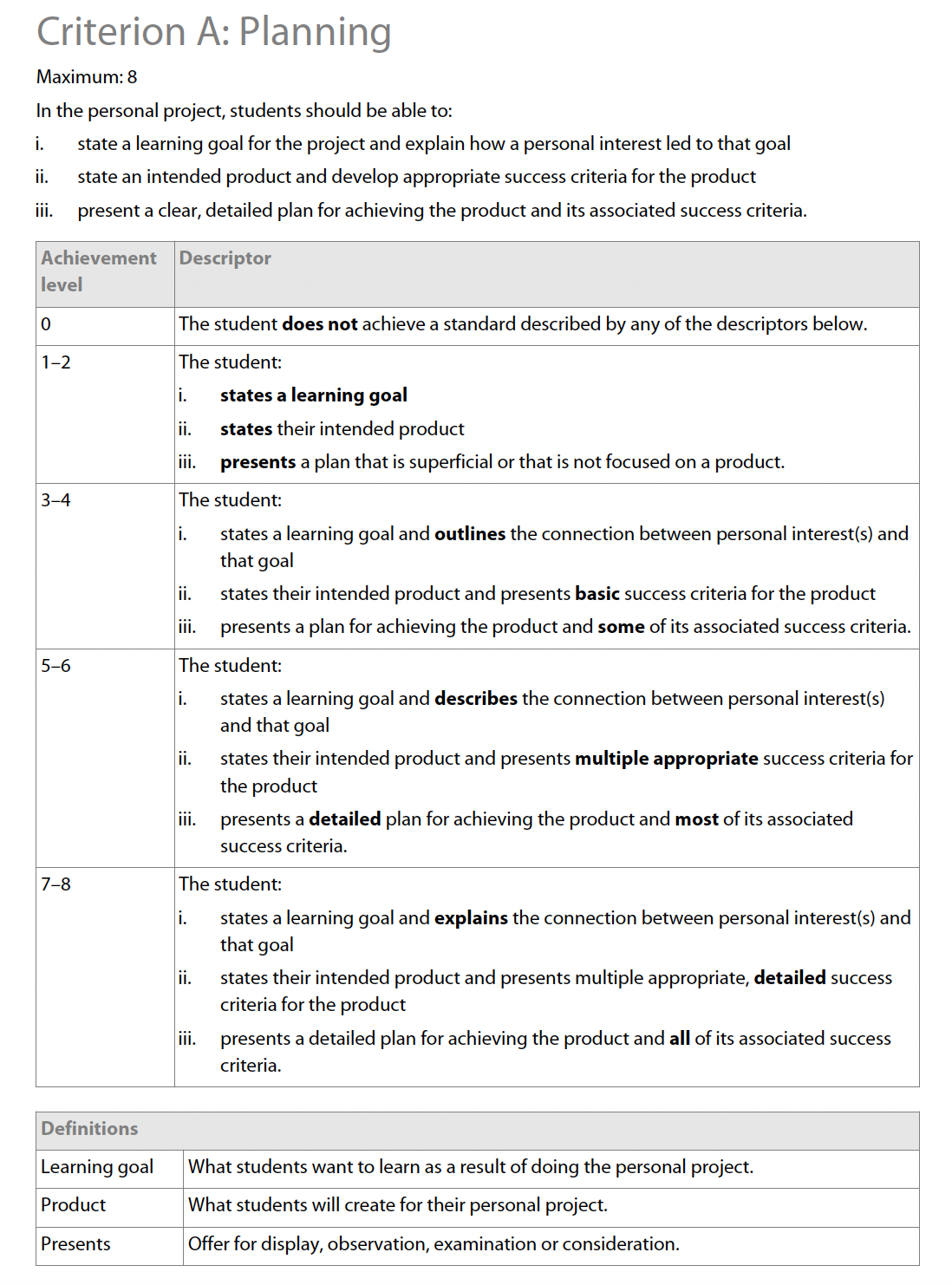
Criterion A
Planning

The student should be able to:
- I. state a learning goal for the project and explain how a personal interest led to that goal
- II. state an intended product and develop appropriate success criteria for the product
- III. present a clear, detailed plan for achieving the product and its associated success criteria
Criterion B
Applying skills

The student should be able to:
- I. explain how the ATL skill(s) was/were applied to help achieve their learning goal
- II. explain how the ATL skill(s) was/were applied to help achieve their product
Criterion C
Reflecting

The student should be able to:
- I. explain the impact of the project on themselves or their learning
- II. evaluate the product based on the success criteria
MYP Personal Project: Step-by-Step Guide

- Identify a topic or issue you are passionate about.
- Consider your hobbies, talents, future aspirations, or a problem you would like to solve.
- Brainstorm possible project ideas.
- Write a clear and achievable project goal.
- Ensure your goal is specific and measurable.
- Explain why the goal is meaningful to you.
Choose the global context that best connects to your project:
- Identities and Relationships
- Orientation in Space and Time
- Personal and Cultural Expression
- Scientific and Technical Innovation
- Globalization and Sustainability
- Fairness and Development
Clearly explain how your project relates to the chosen global context.
Identify the knowledge and skills you need to develop.
Examples include:
- Learning a new software application
- Developing research skills
- Improving design or artistic techniques
- Learning a programming language
- Developing communication or organisational skills
Gather information from a variety of reliable sources.
- Books
- Academic journals
- Websites
- Interviews
- Surveys
- Videos
- Experts in the field
Keep a record of all sources for your bibliography.
Establish clear criteria that define a successful outcome.
Your criteria should be specific, measurable, and relevant to your goal.
Develop a realistic timeline that includes:
- Research
- Planning
- Product development
- Reflection
- Report writing
- Final submission
Monitor your progress regularly.
Throughout the project, document:
- Ideas and brainstorming
- Research findings
- Planning decisions
- Challenges encountered
- Changes made
- Reflections on your learning
Include photographs, sketches, diagrams, and screenshots where appropriate.
Create the final product that demonstrates your learning.
Examples include:
- Artwork
- Mobile application
- Website
- Model
- Performance
- Business plan
- Documentary
- Scientific investigation
- Educational resource
Compare your final product against your success criteria.
Reflect on:
- What worked well
- What could be improved
- Whether you achieved your original goal
Support your evaluation with evidence.
Discuss:
- New knowledge acquired
- ATL (Approaches to Learning) skills developed
- Challenges and how you overcame them
- Personal growth throughout the project